You've thrown out the overripe bananas. You've wiped down the counters. You've rinsed the sink. And yet, every time you walk into your kitchen, there they are — a small cloud of fruit flies hovering near the counter like they own the place.
If you've been troubleshooting everything except your compost pail, you've probably been solving the wrong problem.
In San Diego, where summer temperatures stay warm well into the evening and green bin composting is now legally required under SB 1383, the kitchen compost pail has quietly become the number one source of summer fruit fly infestations in households that are actually trying to do the right thing. The good news is that it's completely fixable — and you don't have to choose between composting and a fly-free kitchen.
Why Your Pail Is Almost Certainly the Source
Fruit flies aren't random. They are extraordinarily good at detecting the specific chemical compounds produced by fermenting and decomposing organic matter — the same process happening inside your kitchen pail right now.
Fruit flies are drawn to the fermentation process in compost; this is where they naturally want to lay their eggs. Females can lay up to 500 eggs at a time, directly on or inside decaying material, and those eggs hatch within 24 to 30 hours.
Here's the part most people miss: fruit flies can be a particular problem in summer because they're attracted to ripe and rotting food, especially bananas, melon, tomatoes, squash and apples. The smell attracts adult flies, which lay their microscopic eggs in the fruit skins — and those eggs might already be present in produce you bring home from the store or farmers market.
That means the flies may not have even originated in your kitchen. They may have arrived on produce, laid dormant, and activated once the scraps hit your warm kitchen pail.
In San Diego, the heat accelerates every stage of this cycle. The fly life cycle from egg to reproducing adult can complete in as little as eight days at room temperature — and San Diego kitchens in summer are rarely at room temperature. By the time you notice adult flies, there are already multiple generations in progress inside whatever is fermenting.
The Produce Bowl Is a Red Herring
Most people's first instinct is to blame the fruit bowl. And yes, fruit flies are attracted to all produce, whether ripe, rotting, or decaying — moving it to the fridge is good practice. But if you've already done that and the flies persist, the pail is almost always where they're actually reproducing.
The fruit bowl is an attractant. The pail is a breeding ground. There's a meaningful difference.
A lidded compost pail sitting in a warm San Diego kitchen, filled with a week's worth of scraps — citrus halves, avocado peels, vegetable trimmings, coffee grounds — is generating fermentation gases continuously. Every time you open the lid, those gases escape and broadcast a location signal to every fruit fly within range. And fruit flies can travel indoors through tiny cracks in your home based on scents they detect from outside.
The Fix: Cut Off the Gas Supply
The reason fruit flies find your pail isn't the scraps themselves — it's the fermentation gases those scraps produce as they decompose. Remove the gas supply and you remove the signal that draws flies in and gives them somewhere to lay eggs.
This is exactly what a paper bag liner does that a plastic one doesn't.
Paper absorbs moisture. Plastic doesn't.
When food scraps land in a bare plastic pail or a plastic-lined pail, the liquid released from decomposing fruit and vegetables pools at the bottom. That pooled liquid is where anaerobic fermentation accelerates fastest and produces the highest concentration of volatile compounds that attract flies.
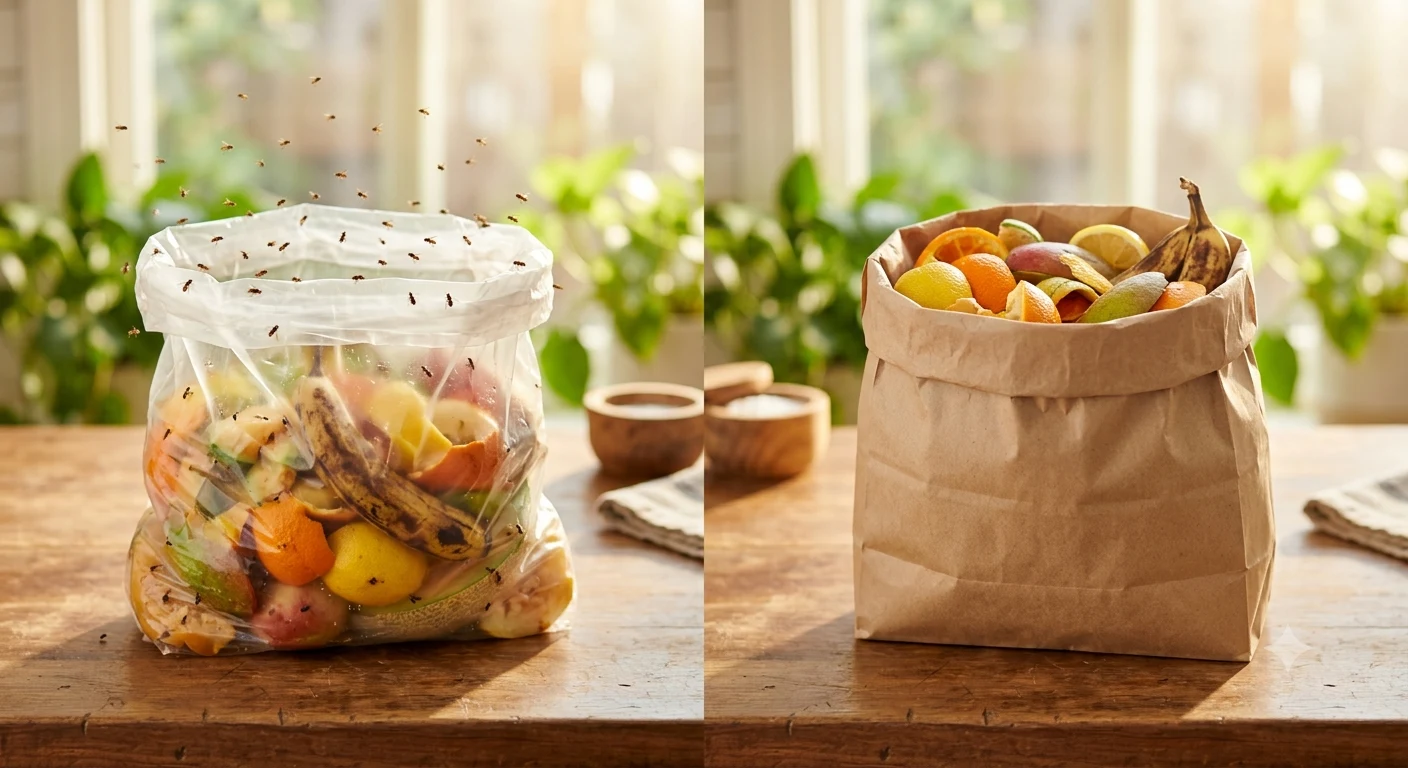
When those same scraps land in a paper bag liner, the moisture is absorbed into the paper rather than pooling. Food rots more slowly when there is no liquid, and as the paper absorbs excess moisture it helps contain and deter the scent that attracts fruit flies in the first place.
An EcoToss paper food waste bag is doing exactly this job, purpose-built for the size and shape of a standard kitchen pail. The paper wicks moisture away from scraps continuously throughout the week, which slows fermentation and dramatically reduces the gas output that fruit flies home in on.
This is also the only liner solution that works with San Diego's green bin program. Plastic bags — including those labeled "compostable" or "biodegradable" — are not accepted in San Diego's green bin and cause contamination at Miramar Greenery. Paper is the only liner that composts cleanly at the facility, with no residue and no microplastics.
Five More Things That Make a Real Difference
1. Keep the lid closed — every single time.
Keeping the lid on your kitchen compost bin is the most important thing you can do to prevent a fruit fly infestation. You may be tempted to leave it open while prepping dinner, but open and close it each time you have more scraps. Every open-lid moment is a broadcast signal. A lidded pail with a paper liner inside generates almost no external gas signal at all.
2. Empty the pail more often in summer.
In winter, a once-a-week transfer to the outdoor green bin is usually fine. In summer, aim for every two to three days. Less time in the kitchen means less fermentation time, which means fewer flies. You don't have to wait for the pail to be full — moving scraps to the outdoor bin early is always the right call when temperatures are high.
3. Freeze the worst offenders.
Freezing food scraps kills any fruit fly eggs already present and produces zero fermentation gases. Keep a small sealed container in the freezer for highly fermentable scraps — overripe fruit, mango peels, banana skins, anything that's already soft. Transfer to the green bin on collection day, still frozen. This one tip alone can break the cycle if you're already dealing with an infestation.
4. Clean the pail between bag changes.
Even with a paper liner, residue builds up on the pail itself over time — a thin film of old liquid that continues to ferment between uses. A quick rinse with hot water and dish soap after each bag change takes 90 seconds and eliminates the background fermentation that keeps flies around even after you've addressed the main scraps.
5. Clear existing flies with a vinegar trap.
If you already have a fruit fly infestation and need to knock it back while your new setup takes effect, pour some apple cider vinegar in a small bowl or cup and cover it tightly with plastic wrap. Poke a few holes in the wrap with a toothpick. The flies will be drawn right to the vinegar and get trapped inside. Set one near the pail and one near wherever you've seen the most activity. Change the liquid every few days. This doesn't solve the root problem but it clears the existing population while your setup does the real work.
What the Flies Are Telling You
Here's the reframe that makes all of this click: fruit flies in your kitchen aren't a sign that you're doing composting wrong. They're a sign that the setup needs one adjustment.
A household that doesn't compost at all has a different problem — all those scraps go to the landfill, where they produce methane instead of compost. A household that composts but ends up with fruit flies has a setup problem, not a composting problem. The fix is not to stop composting.
Under SB 1383, every San Diego resident is required to divert food scraps into organic waste collection. The flies are an inconvenience. Non-compliance is a legal obligation. The better answer is to get the setup right so both problems disappear at once.
The Setup That Eliminates Both Problems
Here's the full configuration that keeps fruit flies out of a San Diego kitchen in summer:
- EcoToss paper bag liner in the kitchen pail — absorbs moisture, suppresses fermentation gases, accepted in San Diego's green bin with no contamination
- Lid closed after every deposit, no exceptions
- Pail emptied into the outdoor green bin every two to three days in summer
- Highly fermentable scraps (overripe fruit, banana peels, mango) going directly into the freezer
- Pail rinsed with hot soapy water at each bag change
- Apple cider vinegar trap running for two weeks if an existing population needs clearing
San Diego summers are long, warm, and full of the exact foods fruit flies love most. The solution isn't to fight that — it's to manage the one thing you can control, which is what happens inside your pail.
EcoToss bags are 100% paper — no plastic, no lining, no coating. They absorb moisture from your scraps, keep your kitchen pail clean, and drop directly into San Diego's green bin on collection day.