San Diego summers are basically built for grilling. The weather cooperates year-round, but from June through September the backyards and patios really come alive — watermelons, corn on the cob, peaches, shrimp, ribs, stone fruit, carne asada. It's the best eating of the year.
It's also the worst time of year for your kitchen pail.
The combination of heavy, wet, sugary summer scraps and San Diego's sustained heat creates ideal conditions for one of the most universally hated household nuisances: fruit flies. A San Diego resident quoted in Voice of San Diego put it plainly after opening his green bin one morning: he was met with a swarm of flying things every single time.
That's a solvable problem. This guide covers exactly what's happening, why summer makes it worse, and the specific setup that keeps your kitchen and green bin manageable through the hottest months of the year.
Why Summer BBQ Scraps Are the Hardest to Manage
Not all food scraps are created equal. Summer produces some of the wettest, heaviest, most fly-attracting waste of the year.
Watermelon rinds are the biggest culprit. A single watermelon produces an enormous volume of thick, sugar-soaked rind that starts fermenting almost immediately in the heat. The fermentation process produces CO2 and volatile compounds that are essentially a homing signal for fruit flies.
Corn cobs and husks are bulky and moisture-laden. Even after the kernels are removed, the cob retains a tremendous amount of liquid that, sitting in an unlined pail in August, becomes a breeding environment within 24 hours.
Stone fruit pits and skins — peaches, nectarines, plums, mangoes — are sticky with natural sugar. Fruit flies don't just eat sugar; they lay their eggs in it. A mango pit left in an open pail in your kitchen is an incubation chamber.
Seafood shells and shrimp heads are arguably the worst of the summer BBQ scraps for both odor and pest attraction. Shellfish decompose rapidly in heat and produce particularly potent sulfur compounds. A bag of shrimp shells sitting in your kitchen on a warm evening will announce itself within hours.
Citrus halves from summer cocktails and agua frescas are high-acid and high-sugar — another strong attractor.
The common thread across all of these is moisture and sugar, and San Diego's summer heat turbocharges the decomposition rate on both. What might take three days to start attracting flies in a cooler climate can happen in an afternoon here.
What's Actually Happening With the Flies
Understanding the biology helps explain why the fixes work.
Fruit flies (Drosophila melanogaster) don't just wander into your kitchen randomly. They detect the specific gases produced by fermenting fruit and rotting organic matter from remarkable distances. Once they locate a food source, females lay up to 500 eggs at a time, often directly on or inside the decaying material. Those eggs hatch within 24 to 30 hours.
In San Diego's summer temperatures — regularly 75°F to 90°F indoors in poorly ventilated spaces — the fly life cycle from egg to reproducing adult can complete in as little as eight days. This is why a small problem becomes an infestation so fast in summer: by the time you notice adult flies, there are likely multiple generations of eggs and larvae already present in whatever attracted the first one.
The moment you remove the food source, the cycle breaks. No accessible fermentation, no egg-laying, no infestation. That's the logic behind every fix in this guide.
The Setup That Actually Works
Line Your Kitchen Pail Before the BBQ, Not After
The single most impactful thing you can do is ensure your food scraps never come into direct contact with air. An EcoToss paper food waste bag lining your kitchen pail before you start cooking does two things simultaneously: it absorbs the moisture from scraps as they land (paper is naturally absorbent, unlike plastic), and it physically contains the volatile fermentation gases that attract flies in the first place.
When watermelon rinds, corn husks, and shrimp shells go into a paper-lined pail rather than sitting loose in bare plastic, the moisture is wicked into the paper rather than pooling at the bottom. No pooling liquid means no fermentation gases, which means flies have nothing to home in on.
This is also why plastic bags — even those marketed as compostable — don't work as well for this purpose. Plastic is impermeable. Moisture from scraps pools at the bottom of a plastic liner in exactly the way that creates the worst conditions. Paper behaves more like a compost pile itself — it absorbs, breathes, and buffers. And plastic bags of any kind, including compostable ones, aren't accepted in San Diego's green bin regardless — so paper is both the more effective choice and the only compliant one.
Handle Seafood Scraps Separately
Shrimp shells, crab legs, fish bones, oyster shells — these need special treatment in summer. San Diego's Environmental Services Department is explicit: refrigerating or freezing food scraps between collection days is one of the most effective things residents can do.
For seafood specifically: after the BBQ, drop shells, heads, and bones into a sealed container or zip-top bag and put it directly in the freezer. Do not let it sit in the kitchen pail overnight. Transfer it to your green bin the morning of collection day — frozen scraps produce zero odor and give flies nothing to work with.
Everything else from the BBQ can go in the EcoToss-lined pail normally. The freezer is specifically for the scraps that would otherwise overwhelm the pail before collection day.
Deal With Watermelon Immediately
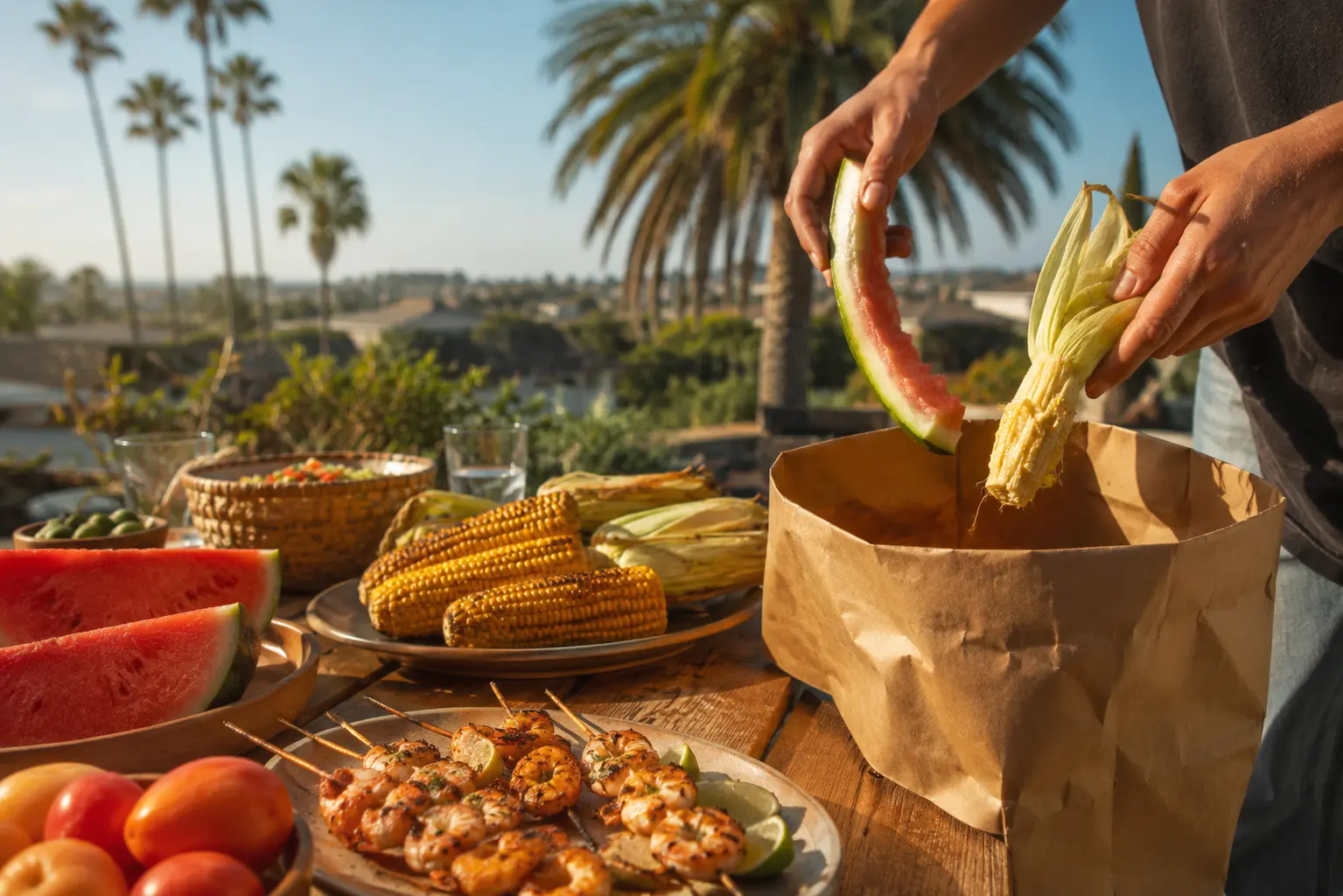
Don't leave cut watermelon rinds sitting on the counter. As soon as you're done eating, cut the rinds into smaller pieces if possible (they compact better in the pail), drop them into your paper-lined kitchen pail, and close the lid. Speed matters here — the larger the surface area of exposed watermelon rind, the faster it starts off-gassing.
If you've had a particularly large group and generated more watermelon waste than your pail can handle before collection day, the rinds can also go directly into the outdoor green bin rather than staging in the kitchen — just make sure the outdoor bin lid is fully closed and the bin is in a shaded spot.
Drain Before You Toss
Before any summer scrap goes into the pail, drain any pooled liquid over the sink. Corn cobs, citrus halves, melon flesh — all of these retain liquid that, left in a closed pail, creates the anaerobic puddle that is ground zero for odor and flies. This takes two extra seconds per scrap and makes a measurable difference in how quickly odor develops.
Close the Lid. Every Time.
The City of San Diego's organic waste guidance is unambiguous: always keep the lid of your green bin closed to deter pests. The same applies to your kitchen pail. Fruit flies don't need much — a slightly ajar lid, a gap where the lid meets the rim, even the brief window when you're loading scraps — to locate and access your pail.
What Goes in the Green Bin From a Summer BBQ
San Diego residents sometimes hesitate on certain summer foods. Here's a clear breakdown.
Yes — all of this belongs in the green bin:
- Watermelon and all melon rinds
- Corn cobs, husks, and silk
- All stone fruit: peach and nectarine pits, plum and mango skins
- Shrimp shells, crab shells, lobster shells, fish bones and skin
- Meat scraps and rib bones
- Citrus halves and peels
- Avocado skins and pits
- Food-soiled paper napkins and paper plates used during the meal
- Leftover salads, dips, and condiments
A helpful rule from San Diego's Environmental Services FAQ: if it grows, it goes in the green bin.
No — keep these out:
- Plastic bags of any kind (including compostable-labeled bags)
- Aluminum foil and foil trays
- Plastic skewers, plastic wrap, or any packaging
- Fruit stickers — peel them off before tossing the produce
- Twist ties and rubber bands
The Summer BBQ Composting Routine
Here's what this looks like as an actual workflow for a Saturday afternoon cookout:
Before you cook: Line the kitchen pail with an EcoToss bag. Pull the outdoor green bin into a shaded spot. Check that the outdoor bin lid closes fully.
During prep: Fruit and vegetable trimmings, citrus halves, melon rinds go in the pail. Shrimp shells and seafood scraps go in a sealed container, into the freezer.
After eating: Plate scrapings, corn cobs, food-soiled napkins and paper plates go in the pail. Close the lid after each deposit.
That evening: If the pail is full, drop the EcoToss bag directly into the outdoor green bin — bag and all — and line the pail fresh for the rest of the week.
Collection morning: Pull the frozen seafood scraps from the freezer. Transfer to the green bin. Set it out. Done.
The whole thing adds maybe three minutes to your BBQ cleanup. No flies, no odor building up in the kitchen, no contamination at Miramar Greenery.
A Note on the Outdoor Bin in Summer
San Diego summers can see green bins sitting in 90°F+ direct sun on concrete driveways. This significantly accelerates decomposition for whatever's already in the bin, which means odor and fly activity increase proportionally.
Two things make a real difference. First, shade — move the bin against a north-facing wall, under an overhang, or in a covered side yard. Second, timing — I Love A Clean San Diego recommends adding food scraps to your outdoor bin as close to collection day as possible rather than immediately after generating them. The less time scraps spend in a hot outdoor bin, the better.
Yard waste — dry leaves, grass clippings, plant trimmings — can help too. Adding a layer of dry yard material on top of food scraps inside the green bin absorbs moisture and creates a physical barrier. This is the same brown-to-green ratio principle used in backyard composting, applied to your curbside collection.
Quick Reference: Summer BBQ Food Waste Checklist
Before the BBQ:
- Line kitchen pail with a fresh EcoToss paper bag
- Move outdoor green bin to a shaded spot
- Pull a sealed container for seafood scraps (goes in freezer)
During and after:
- Drain liquid from scraps before they go in the pail
- Seafood scraps → freezer, not the pail
- Close the kitchen pail lid after each deposit
- Food-soiled paper napkins and plates → pail (these are accepted)
- Peel fruit stickers before tossing produce scraps
- Keep foil, plastic wrap, and plastic skewers out of the green bin
Collection day:
- Transfer seafood scraps from freezer directly to outdoor green bin
- Drop EcoToss bag from kitchen pail into outdoor bin
- Set bin out with lid closed
San Diego summers produce the most food waste, in the most challenging conditions, of any season of the year. The flies aren't inevitable — they're a setup problem. Get the setup right and you can grill all summer without your kitchen turning against you.
EcoToss bags are 100% paper with no plastic lining — sized to fit your kitchen pail, accepted directly in San Diego's green bin, and built for exactly this kind of summer.