If you rent an apartment or condo in San Diego, there's a California law you need to know about — and it's already being enforced.
Senate Bill 1383 isn't a future concern. Jurisdictions across the state have been issuing notices of violation and fines to non-compliant residents and buildings since January 2024. In San Diego, that means your green bin habits are no longer just a personal environmental choice — they're a legal obligation.
The good news? Compliance is genuinely simple. This guide breaks down exactly what SB 1383 requires of you as a renter, what happens if you ignore it, and the one small change that makes the whole thing effortless.
What Is SB 1383, and Why Does It Apply to Renters?
Senate Bill 1383, signed into law in 2016, is California's most aggressive waste reduction legislation in over 30 years. Its goal: reduce the amount of organic waste — food scraps, yard trimmings, and food-soiled paper — sent to landfills by 75% compared to 2014 levels.
Why organic waste specifically? When food scraps decompose in a landfill without oxygen, they produce methane — a greenhouse gas roughly 84 times more potent than carbon dioxide over a 20-year period. In California, decomposing organics account for about 20% of the state's methane emissions. SB 1383 is California's answer to that problem.
Unlike previous recycling laws that focused mainly on businesses, SB 1383 applies to every resident in California — including renters in apartments and condos. If you have access to a green bin (and in San Diego, you do), you are legally required to use it for your food scraps.
What San Diego Renters Are Actually Required to Do
Here's what the law requires of you as a San Diego renter:
1. Separate your organic waste from your trash.Food scraps, food-soiled paper, yard trimmings, and similar materials must be placed in the green bin — not the black trash bin. This includes fruit and vegetable peels, meat and fish scraps, eggshells, coffee grounds, bones, and food-soiled napkins or paper towels.
2. Use your green bin every week.The City of San Diego provides weekly organic waste collection at your normal trash pickup location. Your green bin needs to be used consistently, not just occasionally.
3. Avoid contaminating the green bin.This is the part most residents get wrong. Plastic bags — including bags labeled "compostable" or "biodegradable" — are not allowed in San Diego's green bin. Even a single plastic bag can fragment into thousands of pieces of microplastic during the grinding process at Miramar Greenery, San Diego's composting facility. Only certified paper bags or loose food scraps belong inside.
4. If you live in a multi-family building, your landlord must provide proper bins.Buildings with five or more units are required to subscribe to organic waste collection services and provide clearly labeled containers for tenants. But the sorting responsibility still falls on you.
What Happens If You Don't Comply?
Enforcement of SB 1383 is now very real. Since January 2024, local jurisdictions — including San Diego — have been authorized to issue notices of violation and escalating civil penalties to non-compliant waste generators.
Your hauler or local environmental services team may perform random inspections by opening bags and checking bin contents to identify contamination and improper sorting. You could receive written warnings before fines are issued, but repeated violations mean the fines begin to add up.
For large food-generating businesses, fines can reach thousands of dollars. For individual residents and apartment complexes, the amounts are lower but very much a reality — and the program is scaling up, not winding down.
The bottom line: the "we're still in the education phase" window has closed. San Diego's Environmental Services Department is actively working to improve compliance across the city.
The Problem Most San Diego Renters Don't Know About
Here's where a lot of well-meaning renters go wrong: they think using a plastic "compostable" bag from the grocery store solves the problem. It doesn't.
Bioplastic bags — even those marked as certified compostable — are one of San Diego's top green bin contaminants. The Miramar Greenery composting facility operates on a tight processing timeline. Most bioplastic bags simply don't break down fast enough to be compatible with the facility's process, and they leave behind microplastic residue in the finished compost.
San Diego's own Environmental Services Department has been outspoken about this: plastic bags of any kind, including those marketed as compostable, are a major problem at the facility.
This creates a real headache for renters who want to keep their kitchen pail clean. If you can't use plastic bags, what do you use to line your counter pail?
The Simplest Way to Stay Compliant: A Paper Food Waste Bag
This is exactly the problem EcoToss was designed to solve.
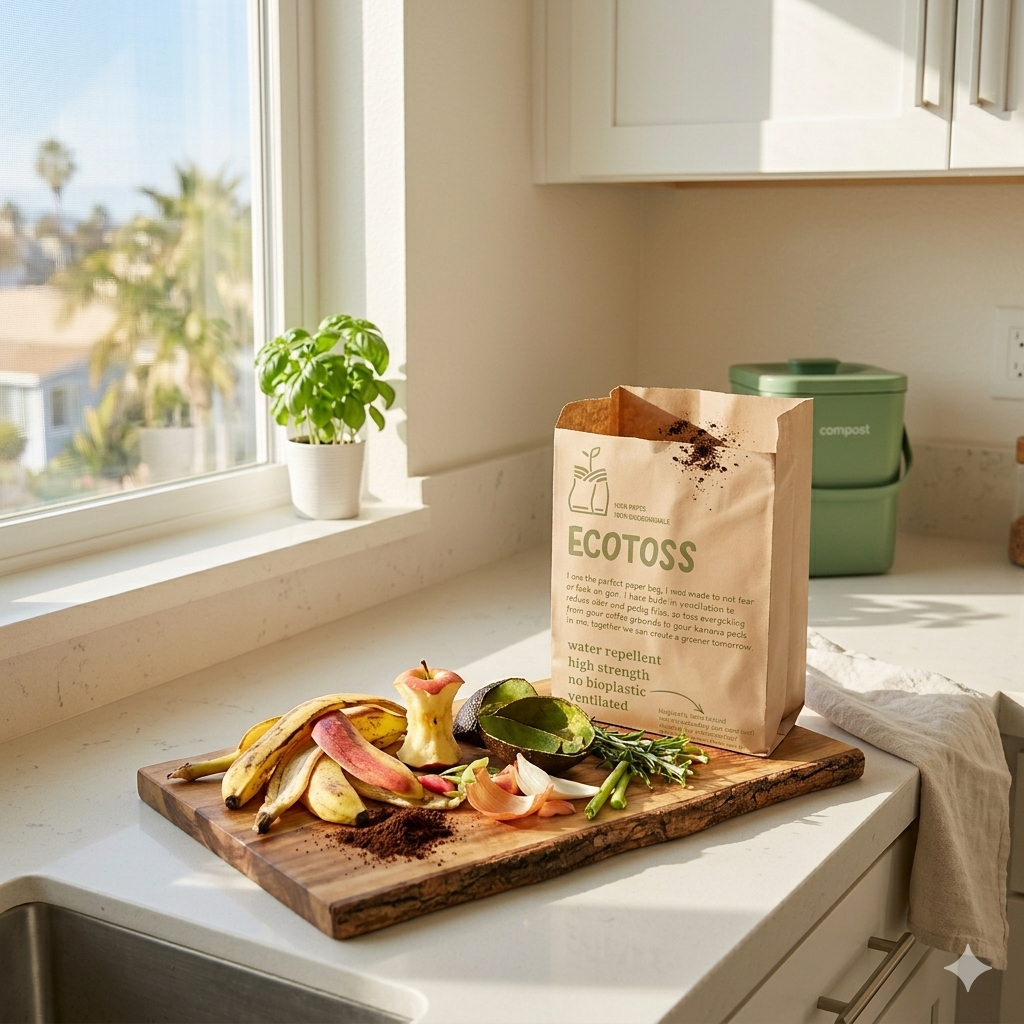
EcoToss bags are 100% paper — no plastic coating, no lining, no bioplastic. They're sized to fit standard kitchen compost pails, and because they're made from paper, they're accepted by San Diego's composting facility without issue. Paper breaks down cleanly in the composting process, leaving no residue behind.
Here's what using EcoToss actually looks like as a renter:
- Line your kitchen pail with an EcoToss bag at the start of the week
- Toss in your scraps — fruit peels, coffee grounds, leftovers, eggshells, meat, fish bones, food-soiled napkins — all of it
- Drop the bag directly into your green bin when it's full — no leaking, no mess, no need to rinse the pail every time
- Set your green bin out on your normal collection day
That's it. No odor building up because soggy scraps are sitting loose in a plastic liner. No bioplastic bag that may or may not break down. No contamination risk at the facility.
For renters in small apartments where kitchen space is limited and access to a hose or utility sink isn't always easy, this matters a lot. The bag contains the mess so your counter pail stays clean, and the whole thing goes into the green bin, bag and all.
A Quick-Reference Checklist for San Diego Renters
Use this to make sure you're meeting SB 1383 requirements:
- You have access to a green bin at your building
- You know what goes in the green bin (food scraps, yard trimmings, food-soiled paper — no plastic)
- You are actively using the green bin every week, not just occasionally
- You are not using plastic or bioplastic bags to line your kitchen pail
- You are using a certified paper bag (like EcoToss) or placing scraps loose in your pail before transferring to the green bin
- Your building's bins are properly labeled (if not, this is your landlord's responsibility — but worth flagging)
What Goes in the Green Bin (and What Doesn't)
Yes — green bin:
- All food scraps: fruit, vegetables, meat, fish, poultry, dairy, eggs, bones
- Coffee grounds and paper coffee filters
- Tea bags (paper only)
- Food-soiled paper: napkins, paper towels, paper plates, pizza boxes
- Yard trimmings: grass clippings, leaves, small branches
No — keep out of the green bin:
- Plastic bags of any kind, including those labeled "compostable" or "biodegradable"
- Styrofoam or foam containers
- Glass, metal, or non-organic waste
- Liquids (drain these before tossing scraps)
The Bottom Line for San Diego Renters
SB 1383 isn't going away, and enforcement is only going to increase as San Diego works toward its sustainability targets. As a renter, you don't need to overhaul your kitchen or build a backyard compost bin. You just need to separate your food scraps and put them in the right bin — every week, without contaminating the load.
Using an EcoToss paper bag in your kitchen pail is the simplest way to do that. It keeps your counter clean, keeps your green bin compliant, and keeps your household on the right side of California law — all without adding any extra steps to your daily routine.
A greener tomorrow really is just a toss away.
Ready to make green bin compliance effortless? Learn more about EcoToss bags →